Healing Weeds - Getting a closer contact with the healing world of herbs and wild plants.

Showing posts with label Weed. Show all posts

Sunday, October 11, 2015

Sweet Chestnut


NL: tamme kastanje / F: Marrons / PL: kasztan jadalny

Sweet chestnuts are incredibly nutritious and offer their fruits abundantly without the need for big human input. All one needs to do is to plant a tree and take some little care of the baby tree (like giving it some water in overly dry seasons) until it reaches a considerable size and from then on, the tree will take care of itself. That puts them among some of the most sustainable foods ever.

Consuming grains means large amounts of land being used for growing the crops, large machines are employed in harvest, usually ruining the soil fertility, then they are processed, stored and transported until it gets to the consumer. Chestnut trees, on the other hand, do a great job in the soil, offer shelter and food to wild animals, birds, insects, clean up the air and on the top of that they yield precious foods that can be easily harvested.


Sweet chestnuts grow easily in most of the Northern hemisphere. It is hardy from zones 5-7.

The skin of sweet chestnuts can be easily removed after steaming or blanching the nuts. Score them by a cross slit at the tufted end (where the colour of the skin is lighter than the rest).
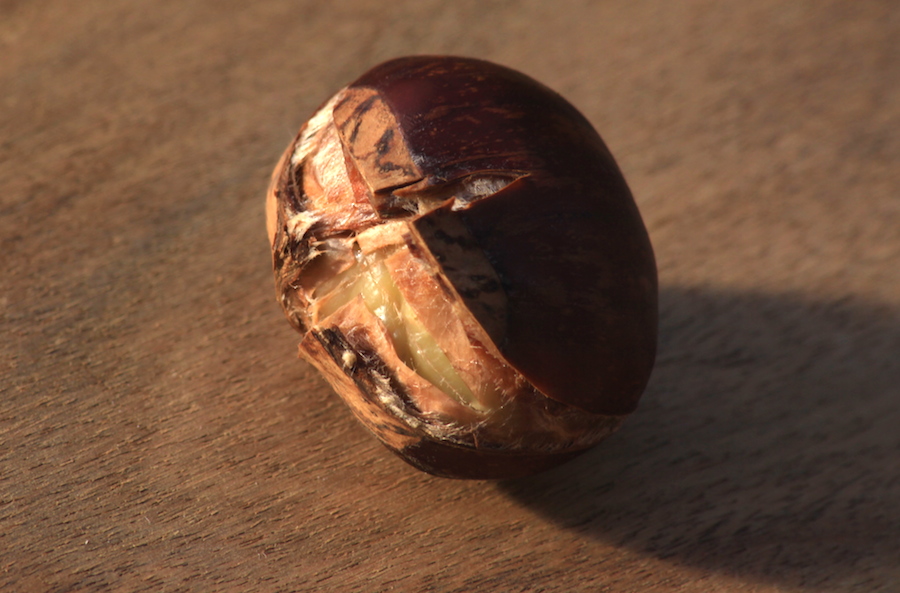
cutting the chestnuts like this makes peeling much easy, specially if they are still hot


In France most people prepare their chestnuts directly on the fire with the use of special pans, like this one:  'La Lyonnaise' Poêle à Marrons . These are pretty handy to use and it allows you to peel both the outer shell and inner dark brown layer (which doesn't bother me but it might give a little rough effect in some creamy recipes). Note that if you don't have direct fire to cook with - meaning, if you use an induction, ceramic or electric cooking stove - these pans are not an option.

Cooked, steamed or roasted chestnuts are very versatile and can be used in endless culinary ideas, sweet or savory. You can use them to thicken desserts, soups, puddings... they can be added to various vegetable stews instead of grains, as they absorb the sauce and help to enrich the dish. They can also be turned into flour for bread making or as a thickener in various culinary creations.


Here are a few examples of where and how I use cooked/steamed chestnuts in:
- smoothies with banana, carob or cocoa powder
- hot drinks, with almond milk and spices (like the recipe in this post) or with chocolate
- creamy sweet spreads with vanille and dates or with - guess what? - melted dark chocolate! ;-)
- savory spreads with nutmeg, chilli pepper, tahini, garden herbs such as rosemary or basil
- tapenades with sundried tomatoes, capers, nutritional yeast, olives, sambal and lemon juice + zest
- stews instead of rice or noodles - I just add them at the end of the cooking, lightly broken
- Thai or Indian curries, also instead of noodles or rice
- pancakes, cakes, bread...
- burgers, with some chickpea flour or oat flakes and spices
- add to seitan recipes, for extra richness
- lasagne white sauce (instead of wheat flour as used in bechamel)
- pizzas and calzones
- croquettes
- or I simply freeze them for later use.


*Note: if you harvest sweet chestnuts for the first time, please make sure to learn the difference between them and horse chestnut, a similar nut that can also be found in similar environments during the same season. Here is a post with pictures that can help you with that:
Sweet chestnuts and Horse chestnuts: how to tell the difference.


Next to its use as foods, chestnut leaves are rich in tannins and can also be used as a first aid herbal medicine to help stop bleedings and diarrhea. Its leaves can be also used in concoctions and syrups to help relieve respiratory ailments.

The tree flowers are harvested during spring time and used in Bach flower remedies.


Now with chestnut harvest season open we'll be cooking every day something with sweet chestnuts. 

Here is a recipe for a Chestnut Spice Latte


Ingredients:

100g steamed and pealed chestnuts (or 300g sweet potato or pumpkin, baked in the oven)
600 ml almond milk (or a mixture oat milk + coconut milk or the milk of your preference)
1 1/2 t.s. cinnamon 
sweetener to taste (sucanat / mascobado, agave syrup, dates, stevia)
1 t.s. cardamom powder
1/4 t.s. mace powder (or nutmeg)
1/4 t.s. allspice powder
1/2 t.s. freshly grated ginger
2 tbsp orange compote or 1/2 t.s.. orange zest (optional)
1 tbsp orange water
Other nice additions are saffron and 1/4 t.s. red chilli flakes

freshly harvested sweet chestnuts are highly nutritious and can take part in so many delicious recipes


Rinse the sweet chestnuts and make shallow cuts on their round part to help steaming go smoother and to help with pealing them. Steam them for 10 minutes or until they show the little cross cuts open up. Peel them while they are still hot as it is much easier than when they cool down.

Mix the cooked and peeled chestnuts with all the other ingredients until smooth and bring the liquid to a quick boil over medium-heat until the chestnut and milk seem well thickened. If too thick, add more milk. Serve immediately.


Feel free to play with the spices of your preference adding a little bit more or less of each spice. The suggested amounts here are more a guideline than a "rule". Each version I make tastes totally different. There is no problem if you don't have all these spices at home. It works fine sometimes only with cinnamon, cardamom and orange compote for instance. 


Here are some nutrition facts from sweet chestnuts (source: http://nutritiondata.self.com/facts/nut-and-seed-products/3143/2) :


Monday, April 28, 2014

Periwinkle

Vinca minor

F: petite pervenche / NL: kleine maagdenpalm

Periwinkle (or minor periwinkle) is a commonly seen as ground cover in both medicinal as ornamental gardens. It has been employed as folk medicine for more than thousand years. It is currently known in herbalism as a replacement of gingko biloba. Similarly to gingko, periwinkle activates blood circulation and it acts as vasodilator, improving blood flow to the tissues and therefore increasing cell metabolism. It enhances various brain functions such as concentration, memory; it reduces anxiety, nervousness and it relieves tinnitus and headaches. It can thus be used to prevent early ageing of the brain cells, such as observed in dementia or Alzheimer. While gingko must be avoided by those using blood thinning drugs or those with a general tendency to bleeding, periwinkle does not have the same counter-indications. Its action stimulating blood flow seems to be balanced by its high tannin content, which has an astringent effect, making it useful also to stop bleeding.

Next to that, periwinkle has also analgesic, hypotensive, antispasmodic, antibacterial and anti-inflammatory properties. It is also known in herbal medicine to help treating various rheumatoid conditions, fibromyalgia, to reduce blood pressure and heavy menstruation. Also used as astringent to help treating diarrhoea and sore throat.

Externally it can be used to disinfect and help wound healing. Also great in mouthwash, to treat bleeding gums, toothache and canker sores. 

Its leaves, flowers and roots are all used in folk medicine, fresh or dried, in infusions, tincture, capsule or extract.

Vinca minor, or periwinkle, is a strong plant native from all over Europe, hardy from zones 4 to 9. It is considered to be invasive, as it grows quickly conquering any territory it finds ahead. If you want to contain its growth, harvest it regularly and use it in infusions to improve blood flow and general brain performance - or if you don’t need it, offer it to friends and family that could benefit from it. What a wonderful present it can be!

A chemical in periwinkle called vincamine can be converted (in laboratory) to the compound vinpocetine, which is sold as a dietary supplement. This isolated extract might have some stronger counter indications, as it does not contain the other substances found in the whole herb. 

Periwinkle should be avoided during pregnancy and lactation.


Here is a video-tour to help you to identify this plant:

Periwinkle - Vinca minor - Helen Linda Drake


More on periwinkle:


Wednesday, October 9, 2013

Mullein

Verbascum thapsus - Family:  Scrophulariaceae

Common names: Great Mullein, Common Mullein / NL: Koningskaars / F: Molène

Mullein is probably one of the most ideal herbs to treat a wide range of conditions of the respiratory tract. The reason for this is that it contains equally balanced medicinal properties that are required to treat the most common respiratory ailments: antiseptic, astringent, demulcent, emollient, expectorant, pectoral, vulnerary and mild sedative. In short, Mullein tones the mucous membranes of the respiratory tract, stimulates expectoration and reduces inflammation. Its entire aerial parts can be used in infusions or tinctures to help relieving coughs, bronchitis, asthma and and other respiratory conditions. Native Americans smoked this herb, as part of the treatment in spasmodic coughs or asthma. Some claim that smoking Mullein has helped them quitting tobacco smoking - especially if combined with Lobelia. 


When preparing the herb in infusion or tincture for internal use (also the flower infused oil if used in the ear), make sure to filter it finely, through a coffee filter or cheese cloth, so as to get rid of all the fine bristles, which could cause throat irritation.

Mullein is also very helpful to heal various intestinal conditions, including hemorrhoids. It has the property to strengthen the intestines.

An oil infused with Mullein flowers make an external remedy with bactericide action. This oil can be used to help healing bites, wounds, eczema, frostbite or to relieve earache. In fact this oil helps to relieve various types of ear problems, including otitis media, deafness resulting from mucus accumulation or ear mites in animals.


In poultices, used externally, it helps to draw splinters and boils. It also helps to speed up the recovery of broken bones.

One amazing use of Mullein - both as poultice as internally - has been shared recently by herbalist Jim McDonald (see link to his website below): to help re-align the spine. He quotes Matthew Wood's Book of Herbal Wisdom on this particular property of Mullein, which I will re-quote here: “It has a moistening, lubricating effect on the synovial membranes… so that it is hydrating to the spine and joints. It is often indicated in back injuries. People think they are untreatable and incurable, but an increase the synovial fluids will make the spine more pliable and comfortable. The vertebra will slip back into place more readily, pain and inflammation will decrease and the condition will get better."

Since Jim McDonald made this information available, Mullein has been widely tested with great results by several herbalists and their closed ones - as one can read in various herbal blogs and forums. It is really worth trying it!! Thank you, Jim!


Mullein helps to relieve various conditions where lymphatic congestions are involved - also (glandular) swellings - in which case it can be used both internally as externally.

One can still find indications for Mullein in the treatment of ringworms, erysipelas, toothache, cramps, blood-shot eyes (external compress), urinary inflammations, urinary incontinence and it can even help to treat certain types of convulsions and migraines. It contains sterol substances that reduce inflammation processes, working as a mild painkiller.

Another folk use of Mullein is to place one leaf inside each of the shoes to stimulate circulation, relieve foot-ache and keep the feet warm.

Other uses for Mullein: one can make a hand drill for making fire or a torch with the stalk, the flowers give a yellow or green dye, its dried leaves and fluffy hair serve as insulation material and can also be made into candle wicks. 


Mullein seeds has insecticide properties, meaning that they contain toxic substances. The seeds should therefore not be ingested or employed in preparations for internal use.


Verbascum nigrum
There are other species of Verbascum that have similar medicinal properties as the Verbascum thapsus. One of them is Verbascum nigrum, pictured on the side.

Want to know more about Mullein? Here is a selection of articles with more extensive details:

Verbascum thapsus, by Survival Plants Memory Course

A Golden Torch: Mullein’s Healing Light, by bearmedicineherbals.com

Mullein, by Jim McDonald

Mullein & Lobelia, by Dr Christopher’s Legacy

Mullein Benefits and side effects - Natural Alternative Remedy.com


Helpful videos on Mullein:

Plant Portrait - Common Mullein, by IdentifythatPlant.com

Mullein: video with Elindria

Mullein: Harvesting tips and how to make syrup, with Linda Bostock

Katrina Blair on some extra uses of Mullein

Wednesday, September 18, 2013

Horseweed

Conyza canadensis
Horseweed / Canadian Fleabane
NL: Canadese fijnstraal / F: Vergerette du Canada

Native from North America, this plant made its way all over Europe and many other parts of the world. It may not be the prettiest plant one would choose to keep in the garden, neither is it among the most popular plants in modern herbalism. Nevertheless Horseweed, or Canadian Fleabane, as it is also called, was used by most Native North Americans tribes to treat various illnesses, including diarrhea, fever, running nose, rhinitis, but also used to arrest bleedings or to relieve stomach aches, earaches or headaches. Externally, it was made into poultices to treat burns and sore joints. Roots were used in decoction teas to treat menstrual complaints. Dried and burned as incense it was used to ward off insects.


In today’s herbalism Horseweed is mostly employed where an astringent is required: diarrhea, internal hemorrhage, nosebleeds, hemorrhoids, etc. It has been recently researched for its antioxidant, antibacterial, antiviral and anti-fungal properties, including against candidiasis - looks promising!

Further one can still find references of folk usages of this plant to treat cholera, rheumatism, tuberculosis, bronchitis, inflamed tonsils, diabetes, menopausal symptoms, kidney and bladder conditions, eczema and ringworm.

It is an edible plant, especially the young leaves, cooked, can be prepared as potherb, or used in the same way as other dark greens. Because of its powerful medicinal properties, it should be eaten sparingly, not in large amounts. It can also be dried and used as food spice - it gives an aromatic flavour to dishes.


Warning: Skin contact with the plant can cause dermatitis in some people.

More information on Conyza canadensis:

Plants for a Future: Conyza canadensis

Antiviral activity of Conyza canadensis (L)

Antibacterial, antioxidant and cytotoxic activities of extracts of Conyza canadensis

Antimicrobial activities of Conyzolide and Conyzoflavone from Conyza canadensis


Tuesday, September 17, 2013

Goldenrod

Solidago canadensis
F: Verge D'or  - Solidage / NL: Guldenroede

Goldenrods can be seen in flower all over the fields, gardens, in most places in Europe from August till October, depending on the region. Its flowers show all their glory when most other plants are no longer in flower, to the joy of the bees, which are delighted to feast on them.

Luckily for Goldenrod's lovers, this plant has been studied by the scientific community and some of its properties have been already recognized - by the German Commision E - for its effectiveness when used in the treatment of illnesses of the urinary tract. Its restorative, anti-inflammatory, tonic and cleansing properties make it one of the top herbs to aid in any kidney and bladder condition, including kidney stones, nephritis and cystitis.


Next to that Goldenrod also has anti-fungal, anti-bacterial, diaphoretic, antiphlogistical, astringent, spasmolytic, hemostatic, anti-mucus, expectorant and anti-oxidant properties. It has been used in folk medicine for centuries to help in the treatment of a wide range of conditions such as seasonal allergies, asthma, colds and flu, tuberculosis, capillary fragility (e.g. varicose veins, hemorrhoids, hemorrhage) and even diabetes mellitus.

Externally it can help disinfecting and healing wounds and various skin problems. It can also be “soaked” in oil to be used in ointments or salves to relieve pain - both muscular and rheumatic pain.

On the top of all these healing properties, Goldenrod has also high amounts of antioxidants - more than green tea!! Its antioxidants work scavenging free-radicals, cleaning up the body, helping to heal and prevent a great deal of illnesses. It is also a delicious tea to use.


Its leaves and flowers are edible, raw or in soups and stews.

There are more than hundred species of Solidago and the most commonly found types (S. virgaurea, S. gigantea, S. canadensis) can apparently all be used in a similar way. Their medicinal properties will surely vary in potency though, depending on the species, on where it grows, etc.


a happy bee feasting on its flowers


In the links below you will find enriching information on Solidago plants:

How to identify Solidago / Goldenrods - LuminEarth

Edible and Medicinal Plants - Goldenrod - Sigma 3 Survival School

Goldenrod: A Torch of Healing - Methow Valley Herbs

Glorious Goldenrod - Susunweed.com


Of Solidago Canadensis: phenolic composition and biological activity

Antioxidant and Radical-Scavenging Activity of Flavonoids From Solidago canadensis

Antibacterial and antimutagenic activity of extracts aboveground parts of three Solidago species.


Tuesday, August 20, 2013

Marshmallow

Althea officinalis

NL: Echte heemst /
F: Guimauve sauvage

Marshmallow is a powerful medicinal herb that has been proven to soothe and heal inflammations an irritations in mucous membranes of the respiratory, urinary and digestive tract. That covers quite a lot of conditions: bronchitis, peptic ulcers, gastritis, cystitis, mouth and throat inflammations, etc.

All parts of the plant are edible and can be used medicinally.

Externally, as poultices or in creams, it promotes cellular healing. It is therefore employed in the treatment of skin inflammations, burns, insect bites, bruises, sprains... its fresh leaves can be lightly crushed between the fingers and rubbed into insect bites and stings to relieve itchiness and to reduce allergic reactions. It can be also infused in oil to be used after shower to keep skin’s health. Just a side note on this: our skin is our major “defense” organ, protecting our body against undesired organisms, so it is a good idea to treat our skin with a thin layer of (herbal) oil after shower.


Old time healers used marshmallow to prevent and heal degenerative conditions, including plagues, tuberculosis and blood losses. Dioscorides prescribed it to neutralize intoxication in the body: “The decoction of the roots and leaves helps all sorts of poison, so as the poison be presently voided by vomit”

The powder of the leaves or roots is used to help to drag pus and inflammatory liquids from gangrenous wounds, tumors, (painful) swellings, boils, abcesses. It is also used to draw out stings, splinters or thorns.

It has a cooling effect and it can help reduce hot flushes during the menopause. It also helps to boost milk production in lactating mothers.

Its demulcent and emollient properties make marshmallow a very popular supporting herb in formulas, as it combines well with many other herbs. The root powder is even used to bind with other medicinal herbs in pills and capsules.


Our ancestors used mallows also as a food source. Its richness in mucilage makes it not as palatable to everyone, so those who are less keen in slimy dishes might consider mixing it with other leafy vegetables, instead of using it pure.

Here are some interesting links to extra information on marshmallow:

Soothing Marshmallow & Marshmallow Infusion - Learning Herbs

Slimy and Sweet - a closer look at Marshmallow - Methow Valley Herbs

Marshmallow (Althea officinalis) - Avena Botanicals

Marshmallow | University of Maryland Medical Center


Tuesday, June 18, 2013

Wood Avens

Geum urbanum

NL: Geel nagelkruid /
F: Benoîte


Other popular names: herb Bennet, colewort and St. Benedict's herb.

Wood avens, as its name suggests, is found in woodlands and other shady places.

The young leaves can be eaten, cooked as potherb. Older leaves can be dried and powdered to be added to herbal salt. The roots can be harvested either in spring, when they can be more aromatic, or from september until late in the winter, as long as the soil is not so hard frosted. The root is the most popular part of this plant to be used in culinary creations. It adds an aromatic hint of cinnamon and cloves to dishes, soups or drinks, such as lemonades or chai.


Wood avens has a long list of medicinal properties. It is a good astringent herb that can help treat diarrhea, hemorrhoids, vaginal discharges, mouth ulcers, throat inflammation. It relieves irritable bowel syndrome and various other gastro-intestinal disorders. In old folk medicine it was believed to be a remedy against poison and dog and snake bites. It apparently helps the liver to do its “detox” work.


Particularly the roots have antiseptic and anti-inflammatory properties. A decoction of the roots can be used as wash to disinfect and heal skin problems. It is even said to help remove spots, freckles and to smooth the skin. A nice ingredient to add to our beauty creams!

The roots are also popular in folk medicine to relieve fevers. It can be dried and stored to be used as first aid remedy, as a quinine substitute, in intermittent fevers.

The dried root can also be also used to make moth repellent sachets for linen cupboards.


In the link below you can have a photographic tour to help you to identify this plant:

Geum urbanum

More information on this plant:

Wood Avens Health Benefits

Geum urbanum - PFAF

Wood Avens, Edibility, Identification, Distribution, by Galloway Wild Foods

Monday, June 17, 2013

White Clover

Trifolium repens
NL: Witte klaver / F: Trèfle blanc

White clover is found growing abundantly in various types of environments and soils. In urban areas it can be spotted all over grass fields as it is widely used to improve lawn quality. It is one of the most popular, easy-to-use green manure plants, helping to fix nitrogen into the soil, strengthening the health of the surrounding plants. It is particularly great to be sown together with crops from the grass family, such as rye, barley, rice... Permaculture master Masanobu Fukuoka used it widely in his highly productive rice fields. 

White clover is also an amazing “living mulch”. It makes a great soil cover, keeping it moist, helping to restore soil fertility and preventing erosion. It is thus handy to have it grown for instance on the sides of raised garden beds or as cover for pathways. It also attracts bees and other pollinators.

It is a highly nutritious edible, particularly the young leaves, which can be eaten raw or prepared as spinach.  The young leaves should be harvested before the plant comes into flower. Flowers and seed pods are also edible and can be dried in a shadowy, ventilated place and kept for further use. The flowers can be used in tea infusions and the dried seeds can be powdered and used to enrich the mineral and protein content of cooked meals. Do not eat the seeds raw.

In the history of herbal medicine white clover has been used as a general tonic, to prevent and treat rheumatic conditions, colds, coughs and also as depurative. The flowers can be prepared as infusion to be used in eye lotions or genital wash to treat leucorrhoea. 

Here is an interesting article on why to grow white clover in the garden:


And here is a short video with a few tips on how to eat it and use it medicinally:


Thursday, June 13, 2013

Ground Elder

Aegopodium podagaria
NL: Zevenblad / F: 
L'égopode podagraire

Also known as goutweed, ground elder is one of the first abundant edible greens that appear in spring time, together with cow parsley and nettles. It has a long history of being used as medicine-food. It was cultivated as food crop in the middle ages (probably before that too), and that seems to me a very smart thing since it is such a strong plant that does not need much care, growing strongly in harsh conditions, at a time when not many other plant foods are available. 

The young tender leaves are preferred, before the plant is in flower. The flowering point can be postponed however by harvesting the top of the plants regularly. When the leaves are a bit more mature they can get a less appealing taste and they may act as laxative. Choosing only younger leaves before the flowers come out seems to be the way to go! They can be prepared as spinach, in stews, soups, sandwich, pies, you name it.


In old folk medicine ground elder got a good reputation for helping to prevent and treat gout, arthritis and rheumatic complaints. For that purpose, ground elder was particular popular in its external applications, as warm poultice (leaves and roots). A poultice of the leaves can also be employed to help heal burns, bites and wounds. It is also diuretic and has a mild sedative effect. 

Here is a video to help you to identify ground elder: